Beijing Jeep

BEIJING JEEP: A Case Study of Western Business in China
Published: 1989, 1997, by Westview Press
ISBN-10: 081333327X
ISBN-13: 978-0813333274
When China opened its doors to the West in the late 1970s, Western businesses jumped at the chance to sell their products to the most populous nation in the world.
Boardrooms everywhere buzzed with excitement—a Coke for every citizen, a television for every family, a personal computer for every office.
At no other time have the institutions of Western capitalism tried to do business with a communist state to the extent that they did in China under Deng Xiaoping. Yet, over the decade leading up to the bloody events in and around Tiananmen Square, that experiment produced growing disappointment on both sides, and a vision of capturing the world’s largest market faded.
Picked as one of Fortune Magazine’s “75 Smartest Books We Know,” this updated version of Beijing Jeep, traces the history of the stormy romance between American business and Chinese communism through the experiences of American Motors and its operation in China, Beijing Jeep, a closely watched joint venture often visited by American politicians and Chinese leaders.
Jim Mann explains how some of the world’s savviest executives completely misjudged the business climate and recounts how the Chinese, who acquired valuable new technology at virtually no expense to themselves, ultimately outcapitalized the capitalists. And, in a new epilogue, Mann revisits and updates the events which constituted the main issues of the first edition.
Elegantly written, brilliantly reported, Beijing Jeep is a cautionary tale about the West’s age-old quest to do business in the Middle Kingdom.
About Face

ABOUT FACE: A History of America’s Curious Relationship, from Nixon to Clinton
Published: 1998, by Alfred A. Knopf
ISBN-10: 0679768610
ISBN-13: 978-0679768616
This is the fascinating inside story of the people, forces, politics and diplomacy that have shaped contemporary relations between the United States and China.
James Mann, the Beijing bureau chief for the Los Angeles Timesfrom 1984 to 1987, draws on hundreds of newly uncovered government documents, scores of interviews and his own experiences in writing this superb investigative history.
Mann begins with an account of the process by which Richard Nixon and Henry Kissinger first courted and built up ties to China’s Communist government in an attempt to find a way out of the war in Vietnam.
At first, the aim was to create flexibility for the United States in dealing with both the Soviet Union and China; but gradually, as the 1970s progressed, the opening to China took on a life and momentum of its own.
During the Carter and Reagan administrations, American leaders saw China as an ally against the Soviet Union, and a tacit understanding emerged that the United States would not subject China to the standards and principles applied to other countries.
We are shown how subsequent administrations failed to construct a new framework for dealing with China–President Bush tried to preserve the old American relationship with Beijing, and President Clinton has been unsuccessful in his efforts to create something new.
Mann also reveals little-known episodes in the history of U.S.-China relations: that the price of Kissinger’s first visit to China in 1971 was a secret promise that the United States would never support independence for Taiwan; how the United States and China worked together in guerrilla operations in Afghanistan and Cambodia; how the movement to restrict China’s trade benefits originated and how Bill Clinton came to support these efforts during his1992 presidential campaign.
The disclosure of new information, coupled with Mann’s incisive and compelling analysis, makes About Face a work that is sure to shed light on the current debate on the United States’ relations with China.
Rise of the Vulcans

RISE OF THE VULCANS: The History of Bush’s War Cabinet
Published: 2004, by Viking/Penguin
ISBN: 978-0-14-303489-6
When George W. Bush campaigned for the White House, he was such a novice in foreign policy that he couldn’t name the president of Pakistan and momentarily suggested he thought the Taliban was a rock-and-roll band.
But he relied upon a group called the Vulcans—an inner circle of advisers with a long, shared experience in government, dating back to the Nixon, Ford, Reagan and first Bush administrations. After returning to power in 2001, the Vulcans were widely expected to restore U.S. foreign policy to what it had been under George H. W. Bush and previous Republican administrations.
Instead, the Vulcans put America on an entirely new and different course, adopting a far-reaching set of ideas that changed the world and America’s role in it.
Rise of the Vulcans is nothing less than a detailed, incisive thirty-five-year history of the top six members of the Vulcans—Dick Cheney, Donald Rumsfeld, Colin Powell, Paul Wolfowitz, Richard Armitage, and Condoleezza Rice—and the era of American dominance they represent.
It is the story of the lives, ideas and careers of Bush’s war cabinet—the group of Washington insiders who took charge of America’s response to September 11 and led the nation into its wars in Afghanistan and Iraq.
Separately, each of these stories sheds astonishing light not only on the formative influences that brought these nascent leaders from obscurity to the pinnacle of power, but also on the experiences, conflicts and competitions that prefigured their actions on the present world stage.
Taken together, the individuals in this book represent a unique generation in American history—a generation that might be compared to the “wise men” who shaped American policy after World War II or the “best and brightest” who prosecuted the war in Vietnam. Over the past three decades, since the time of Vietnam, these individuals have gradually led the way in shaping a new vision of an unchallengeable America seeking to dominate the globe through its military power.
The China Fantasy
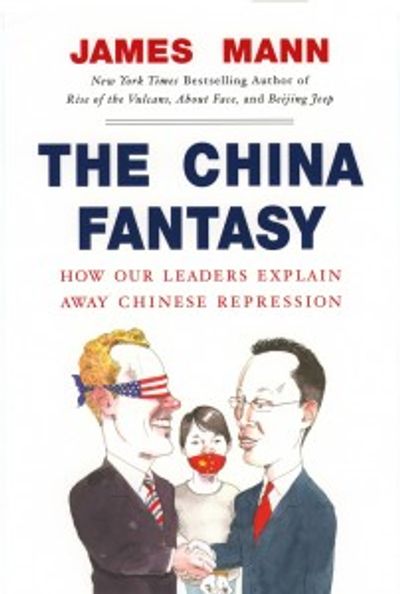
THE CHINA FANTASY: How our Leaders Explain Away Chinese Repression
Published: 2006, by Viking/Penguin
ISBN: 978-0-14-311292-1
One of our most perceptive China experts, James Mann has penned a vital wake-up call to all who are ignorant of America’s true relationship with the Asian giant.
Our leaders may posit a China drawn to increasing liberalization through the power of the free market, but Mann asks us to consider a very real alternative: What if China’s economy continues to expand but its government remains as dismissive of democracy and human rights as it is now?
Calling for an end to the current policy of overlooking China’s abuses for the sake of business opportunities, Mann presents a must-read book for anyone interested in global affairs.
“From Clinton to Bush to Obama, the prevailing belief was engagement with China would make China more like the West.
Instead, as Mr. Mann predicted, China has gone in the opposite direction.”
—Jane Perlez and Javier Hernandez, “President Xi’s Strongman Rule Raises New Fears of Hostility and Repression” New York Times, Feb. 25, 2018
“Ten years ago the journalist James Mann published a book called The China Fantasy, in which he criticized American policymakers for using something he called “the Soothing Scenario” to justify the policy of diplomatic and economic engagement with China. According to this view, China’s exposure to the benefits of globalization would lead the country to embrace democratic institutions and support the American-led world order. Instead, Mann predicted, China would remain an authoritarian country, and its success would encourage other authoritarian regimes to resist pressures to change. Mann’s prediction turned out to be true.”
—Andrew Nathan, “The Chinese World Order,” The New York Review of Books, Oct. 12, 2017
“New Book on China Raises a Storm,”
—The New York Times, Nov. 18, 2007
“What’s Your China Fantasy”: A Debate
Foreign Policy, May 15, 2007
The Rebellion of Ronald Reagan
THE REBELLION OF RONALD REAGAN: A History of the End of the Cold War
Published: March 9, 2009, by Viking/Penguin
ISBN: 978-0-670-02054-6
“James Mann, whose speciality is the murky world of Republican policymaking, and whose 2004 book on George Bush’s war cabinet, “Rise of the Vulcans”, was a deserved hit, has produced a winner again.”
— The Economist, Feb. 26, 2009
In The Rebellion of Ronald Reagan, New York Times bestselling author James Mann directs his keen analysis to Ronald Reagan’s role in ending the Cold War.
Drawing on new interviews and previously unavailable documents, Mann offers a fresh and compelling narrative—a new history assessing what Reagan did, and did not do, to help bring America’s four-decade conflict with the Soviet Union to a close.
As he did so masterfully in Rise of the Vulcans, Mann sheds new light on the hidden aspects of American foreign policy.
He reveals previously undisclosed secret messages between Reagan and Moscow; internal White House intrigues; and battles with leading figures such as Nixon and Kissinger, who repeatedly questioned Reagan’s unfolding diplomacy with Mikhail Gorbachev.
He details the background and fierce debate over Reagan’s famous Berlin Wall speech and shows how it fit into Reagan’s policies. Ultimately, Mann dispels the facile stereotypes of Reagan in favor of a levelheaded, cogent understanding of a determined president and his strategy.
This book finally answers the troubling questions about Reagan’s actual role in the crumbling of Soviet power; and concludes that by recognizing the significance of Gorbachev, Reagan helped bring the Cold War to a close.
The Obamians

THE OBAMIANS: The Struggle Inside the White House to Redefine American Power
Published: 2012, by Viking/Penguin
ISBN: 978-0-670-02376-9
“James Mann is unique among writers on contemporary American foreign policy. He combines a reporter’s eye for detail and anecdote with a scholar’s grasp of the broad sweep of historical events.”
–Aaron Friedberg, professor of politics and international affairs, Woodrow Wilson University
“James Mann gives us valuable insight into the crafting of American foreign policy in the Obama administration.”
–Nancy Pelosi
“James Mann has pioneered a new and immensely readable genre: an in-depth group portrait of foreign-policy advisors whose backgrounds and interactions help explain the worldview and policies of the president they serve. He did that superbly in Rise of the Vulcans about George W. Bush’s inner circle, and he’s done it again with The Obamians.
–Strobe Talbott, president, The Brookings Institution
In THE OBAMIANS: The Struggle Inside the White House to Redefine American Power (Viking; On-sale Date: June 14, 2012; ISBN 9780670023769; 400 pages; $26.95), bestselling author and acclaimed reporter James Mann, takes readers inside the back rooms of the White House, Pentagon, State Department and CIA to reveal the interplay of events, ideas, personalities and conflicts that drive America’s foreign policy at the highest levels. Having written the definitive book on Bush’s war cabinet (The New York Times bestseller, The Rise of the Vulcans), and a nuanced exploration of the true nature of Reagan’s role in ending the Cold War (The Rebellion of Ronald Reagan), Mann now provides the definitive book on Barack Obama’s foreign policy team.
At the heart of the foreign policy struggle are the generational conflicts between the Democratic establishment—still influenced by the legacy of Vietnam—and Obama’s inner circle of largely unknown, relatively youthful advisors who came of age after the end of the Cold War. When President Obama took office in 2009, he brought with him a fresh group of advisors intent on carving out a new global role for America in the wake of the Bush Administration’s war in Iraq and the resulting mistrust of the United States throughout the world. Mann has conducted hundreds of interviews with prominent government officials, politicians and those close to Obama.
THE OBAMIANS provides stunning new details as Mann takes readers through the Obama administration’s foreign policy efforts. Exhaustively reported and lucidly argued, THE OBAMIANS is a compelling, even-handed account of the administration’s struggle to enact a coherent and effective set of policies in a time of global turmoil.
THE OBAMIANS is a sequel of sorts to The Rise of the Vulcans, which was described by Michiko Kakutani as “compelling … lucid, shrewd, and … blessedly level-headed.” No other book so far has provided such a global accounting of this historic president and his inner circle, and of how Obama’s policies may or may not continue to shape America and the world. James Mann, admired for his balanced view of politically polarized issues, is uniquely qualified to write this book.
“Journalist Mann, author of The Rise of the Vulcans, offers an insider’s account of Barack Obama’s foreign policy team.”
–Publishers Weekly
“An absorbing narrative as much about the personalities as the policy itself. This book is for serious and thoughtful readers of any political persuasion looking for in-depth information on Obama’s foreign policy thus far.”
–Library Journal
“This book effectively represents a companion volume to Mann’s well-regarded Rise of the Vulcans (2004), which explored the ascendancy of neoconservatives in President George W. Bush’s administration. Taking a similar approach here, Mann proves to be a deft, discerning reporter.”
–Kirkus
Media
MSNBC Andrea Mitchell: “Obama and American Power” Click HERE
CBS News: “Who are the Obamians?” Click HERE
CBS News Q & A Click HERE
Politics and Prose, Washington D.C. June 26 Click HERE for C-SPAN video or HERE for YouTube
Los Angeles Times op-ed by James Mann Click HERE
George W. Bush
GEORGE W. BUSH
Published: 2015, for The American Presidents series by Henry Holt
ISBN: 978-0-8050-9397
The controversial president whose time in office was defined by the September 11 attacks and the war on terror
George W. Bush stirred powerful feelings on both sides of the aisle. Republicans viewed him as a resolute leader who guided America through the September 11 attacks and retaliated in Afghanistan and Iraq, while Democrats saw him as an overmatched president who led America into two inconclusive wars that sapped the nation’s resources and diminished its stature. When Bush left office amid a growing financial crisis, both parties were eager to move on.
In this assessment of the nation’s forty-third president, James Mann sheds light on why George W. Bush made the decisions that shaped his presidency, what went wrong, and how the internal debates and fissures within his administration played out in such a charged atmosphere. He shows how and why Bush became such a polarizing figure in both domestic and foreign affairs, and he examines the origins and enduring impact of Bush’s most consequential actions-including Iraq, the tax cuts, and the war on terror. In this way, Mann points the way to a more complete understanding of George W. Bush and his times.
“[Mann weaves] extensive interviewing and archival research to produce insightful analyses and fresh perspectives on our own times.… George W. Bush is also the relatively rare book about our 43rd president that could be read appreciatively by both supporters and detractors.… Mann adopts an almost studied neutrality, adhering for the most part to the unbiased tone of the newspaper reporter.”
—The Washington Post
“[The American Presidents Series] offers brisk biographies of each president in crisp, straightforward prose, a formula Mann follows with precision.”
—The Christian Science Monitor
“The latest volume in the American Presidents series meets its goal of providing a concise yet thorough biography of the 43rd president. Mann’s claim that Bush’s tenure ‘was, by any standard, one of the most consequential presidencies in American history’ is made from a balanced assessment of the facts.” —Publishers Weekly
“An insightful biography.”
—Kirkus Reviews
“[Bush’s tenure] occurred ‘at a critical juncture in American history’…. As president, that critical juncture overtook him, first and foremost on 9/11 but as fatefully later with Hurricane Katrina and the 2008 financial crash…A sober overview.”
—Booklist
THE GREAT RIFT
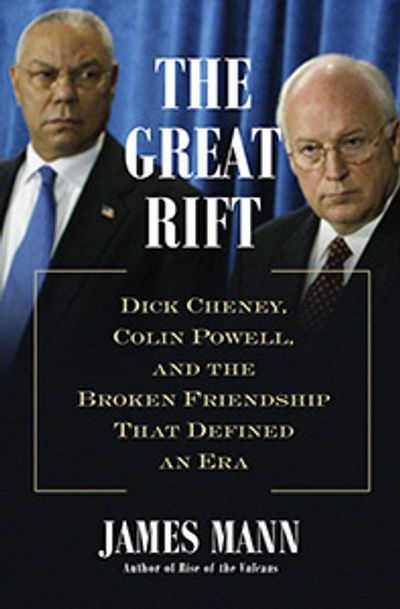
THE GREAT RIFT: Dick Cheney, Colin Powell, and the Broken Friendship That Defined an Era
Published: 2020 by Henry Holt
ISBN: 978-1-62-779755-9
The Great Rift is a sweeping history of the intertwined careers of Dick Cheney and Colin Powell, whose rivalry and conflicting views of U.S. national security color our political debate to this day.
Dick Cheney and Colin Powell emerged on the national scene more than thirty years ago, and it is easy to forget that they were once allies. The two men collaborated closely in the successful American wars in Panama and Iraq during the presidency of George H. W. Bush–but from this pinnacle, conflicts of ideology and sensibility drove them apart. Returning to government service under George W. Bush in 2001, they (and their respective allies within the administration) fell into ever-deepening antagonism over the role America should play in a world marked by terrorism and other nontraditional threats.
In a wide-ranging, deeply researched, and dramatic narrative, James Mann explores each man’s biography and philosophical predispositions to show how and why this deep and permanent rupture occurred. Through dozens of original interviews and surprising revelations from presidential archives, he brings to life the very human story of how this influential friendship turned so sour and how the enmity of these two powerful men colored the way America acts in the world.
Praise for The Great Rift
“In his excellent recounting of the rise and fall of the friendship of two major figures in the two Bush presidencies, James Mann tells, in a vivid and compelling way, the story of the American response to twenty years of earthshaking global events: the end of the Cold War, the terrorist attacks of September 11, 2001, and especially the two wars against Saddam Hussein.”
—Michael Mandelbaum, author of The Rise and Fall of Peace on Earth
“The Great Rift cements James Mann’s reputation as an essential historian of U.S. foreign policy in modern times. This riveting character study shows how two of the Bush family’s foremost advisers went from allies to adversaries—and what their split tells us about the Republican party in the age of Trump. Mann has done that rare thing: he has captured history in motion.”
—David Greenberg, author of Republic of Spin and Nixon’s Shadow
“In James Mann’s powerful new book, The Great Rift, Iraq bookends the fraught and consequential relationship between Colin Powell and Dick Cheney. Deftly using their cooperation and competition as his lens, Mann provides a trenchant, engrossing, and ultimately sad chronicle of the rise and fall of American global leadership after the Cold War.”
—Timothy Naftali, author of George H. W. Bush and founding director of the federal Richard Nixon Presidential Library and Museum
“More than an account of an intimate Washington partnership that degenerated into mutual loathing, this is a study of the limits of unswerving conviction on the one hand, and anti-conceptual pragmatism on the other. As such, it is a warning for the future no less than an account of the past.”
—Eliot A. Cohen, former counselor of the Department of State and author of The Big Stick and Supreme Command
“James Mann’s gripping account of the rise and fall of Dick Cheney and Colin Powell is almost Shakespearean in its pitch-perfect portrayal of two close friends turned bitter foes, whose ambition and internecine warfare played a key role in America’s disastrous involvement in the war in Iraq, with grievous effects that continue to this day.”
—Lynne Olson, bestselling author of Madame Fourcade’s Secret War and Citizens of London
“In this brisk, penetrating narrative, James Mann offers a thoroughly original way of understanding critical events at the highest levels of government over the last three decades. The Great Rift is outstanding.”
—Jonathan Alter, author of The Defining Moment: FDR’s Hundred Days and the Triumph of Hope and The Center Holds: Obama and His Enemies